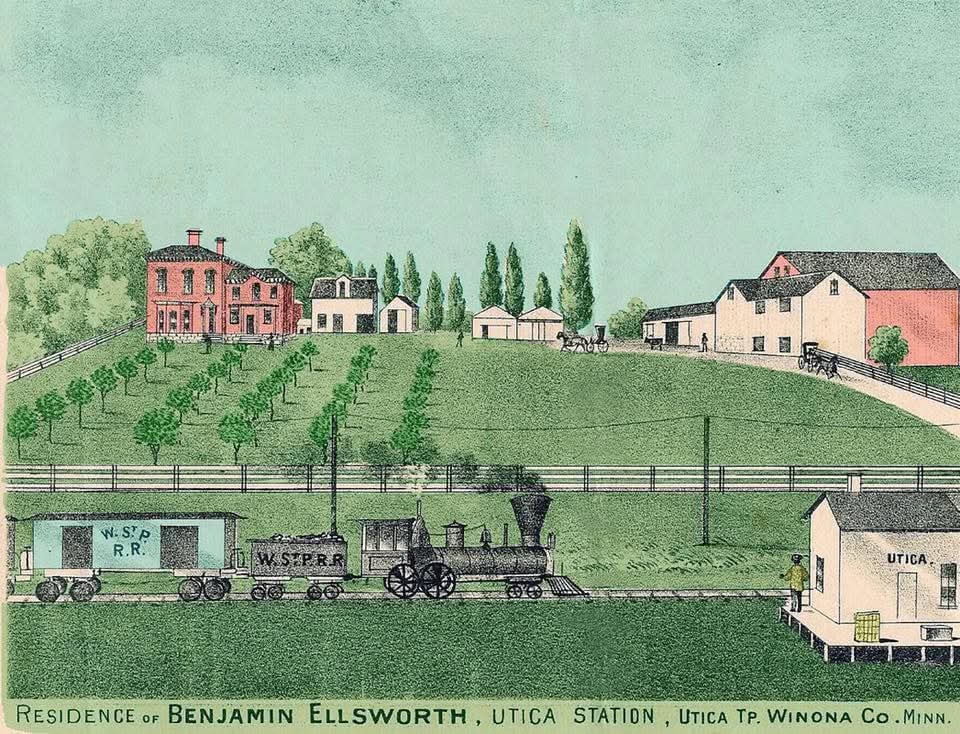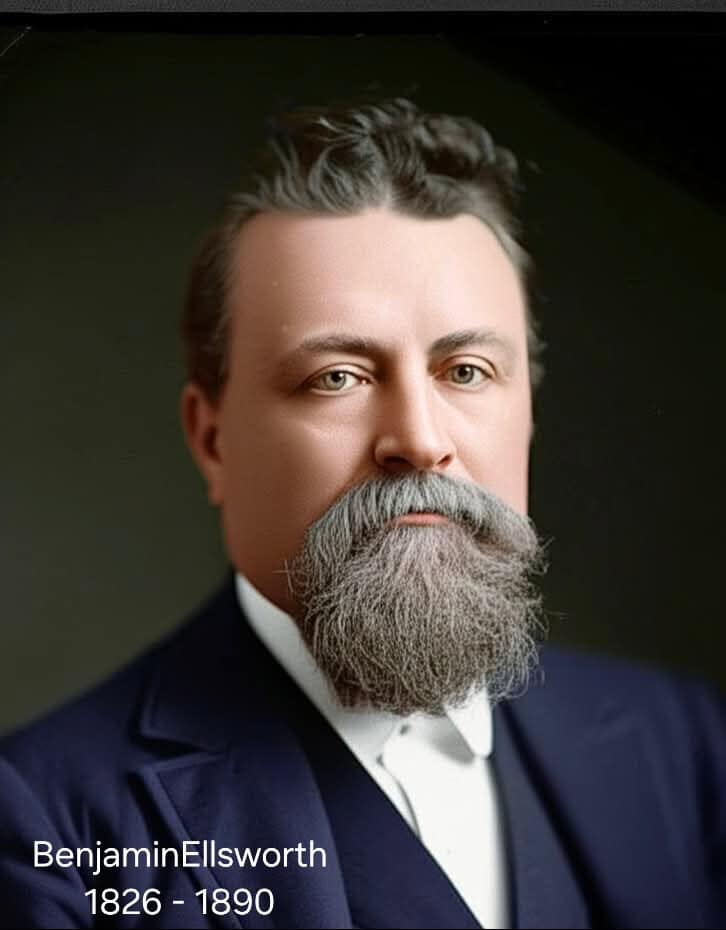
Utica is a small city with a population of 263 in 2026. It offers a rural atmosphere, conservative feel with above-average public schools and a high rate of home ownership. Utica was platted in 1866. The city was named after Utica, New York. The Benjamin Ellsworth House, built in 1873 by the town’s founder, is listed on the National Register of Historic Places
The City of Utica is located in Utica Township in western Winona County, which primarily consists of agricultural land. The area of the City is approximately two miles square, it is primarily made up of residential, light industrial, and commercial properties.
By Cindy Timm, Utica City Clerk
May 2026
According to information provided by the Winona County Historical Society, the first permanent settlement of Utica was an unincorporated village in the fall of 1854. Settlers included Andrew Peterman and Peter Raymond of Indiana, Henry and Lyman Raymond of New York, and a Rev. William Sweet, E.H. Barret, Dr. John Bentley and two others named Hall and Mallroy, who spent the winter here.
The 1883 Winona County History Book describes a colorful lore to Utica’s early settlement: “Collin Rice also came and took claim and built a sod house in the fall of 1954; the next spring he broughthis family and lived a short time in this house. Mrs. Rice relates that one morning while washing dishes she happened to look up and discover a snake lying close under a roof on a shelf formed by the sod wall, and surveying the scene with quiet contentment. The good lady’s contentment was not so quiet, and the intruder was soon banished”.
During the fall of 1854 the first child was born in the town to Dr. Bentley, and was christened Harriet. The first marriage in the town was performed in 1857 by Bentley, as justice of the peace, to unite Frank Gleason and Genevra Bruce. The 1883 history notes that the couple sampled Bentley’s easy manner of doing business when ordered by the doctor to stand and join hands and he stated “By virtue of the authority vested in me by the Territory of Minnesota, I pronounce you man and wife.”
Bentley was elected to his office as justice of the peace in the fall of 1855. Others elected to posts at this time were trustees Collin Rice, D. Cheatham and Moses Pike.
The City of Utica is in sections 18 and 19 of Utica Township (Organized May 11, 1858). Utica was platted in 1866 by Benjamin Ellsworth, and officially incorporated into a village on November 20, 1893. The town was named by Dr. John Bentley, a name derived from the ancient city of Utica, founded by the Phoenicians in North Africa. The post office began in 1856 in Bentley’s home, but was later moved to its own building. Ellsworth owned the platted town site and constructed the first building in 1863, a grain warehouse, on the advent of the railroad. Utica was platted at right angles to the railroad, and had 50 lots. The next buildings erected were a store occupied by Gideon Peterman, another general store run by L.C. Bates and a hotel built by A.D. Ellsworth.
In 1874, Benjamin Ellsworth built a fine 17 room home (plans prepared by C.G. Maybury of Winona) constructed of brick made from the subsoil on his farm. The house still stands today on the north side of Utica across Highway 14 and remains on of Utica’s most significant historic landmarks. The Ellsworth family legacy continues with Jim living in Benjamin’s home and Michael (5 th Generation) living in Utica today. On May 16, 1885 when a fire swept through Utica, the Ellsworth home was only one of two buildings tosurvive. A strong southwest wind spread the fire from building to building, and postmaster saved the mail by loading it into a wagon and removing it from town.
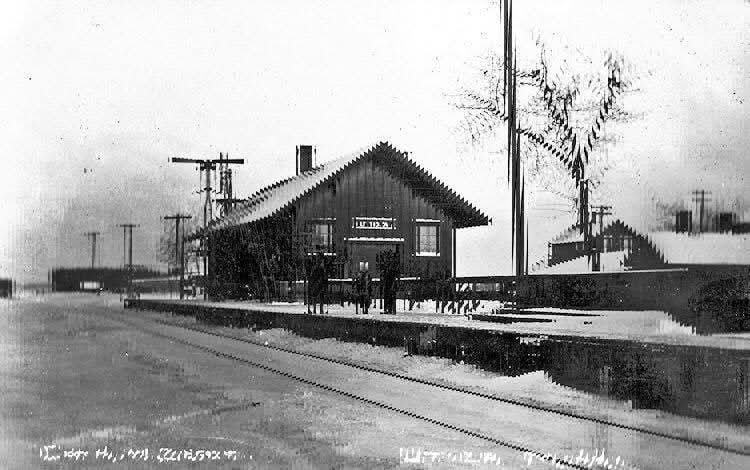
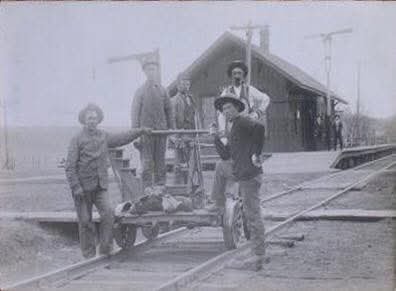
History notes that in 1889 the Chicago Great Western Railroad came to Utica, and in 1900 the Chicago Northwestern took over. Utica area farmers shipped their crops via the railroad, including potatoes, wheat, barley, corn and sugar beets.
The Utica Farmers Elevator was organized by a Robert D. Loudon in 1908, who also started the First State Bank of Utica in 1907. The business was run as a cooperative and handled 200,000 bushels of grain each year.
Board members included William Sackreiter, Fred Robertson, Benjamin Campbell, Hugh Currie, L.J. Holt, Charles Kelley, Alexander Campbell, A.R. Klaveter and Loudon.
Loudon was not only known as the town banker and the fiscal director of the elevator, but was the first Utica resident to own a car. The car cost Loudon $1,500.00 and traveled 20 to 25 miles an hour. Winona County History books have recorded that Loudon and his wife built a “model” home in Utica in the early 1900’s. That home on 2nd St. still stands today and is owned by Isabelle Timm.
In terms of religion, the Presbyterians have had an enduring history in Utica. In the 1860’s Presbyterians met in homes and a school house. During 1892, the First Presbyterian Church was officially organized, and a church building constructed and completed in 1894 for about $1,800.00. That building still stands on South Center St., with the Presbyterians still using it for Sunday worship and other church activities.
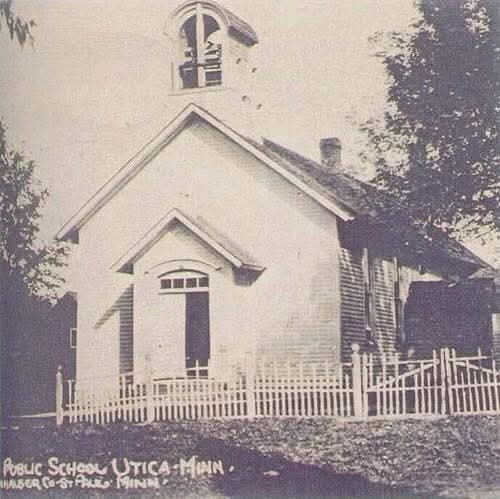
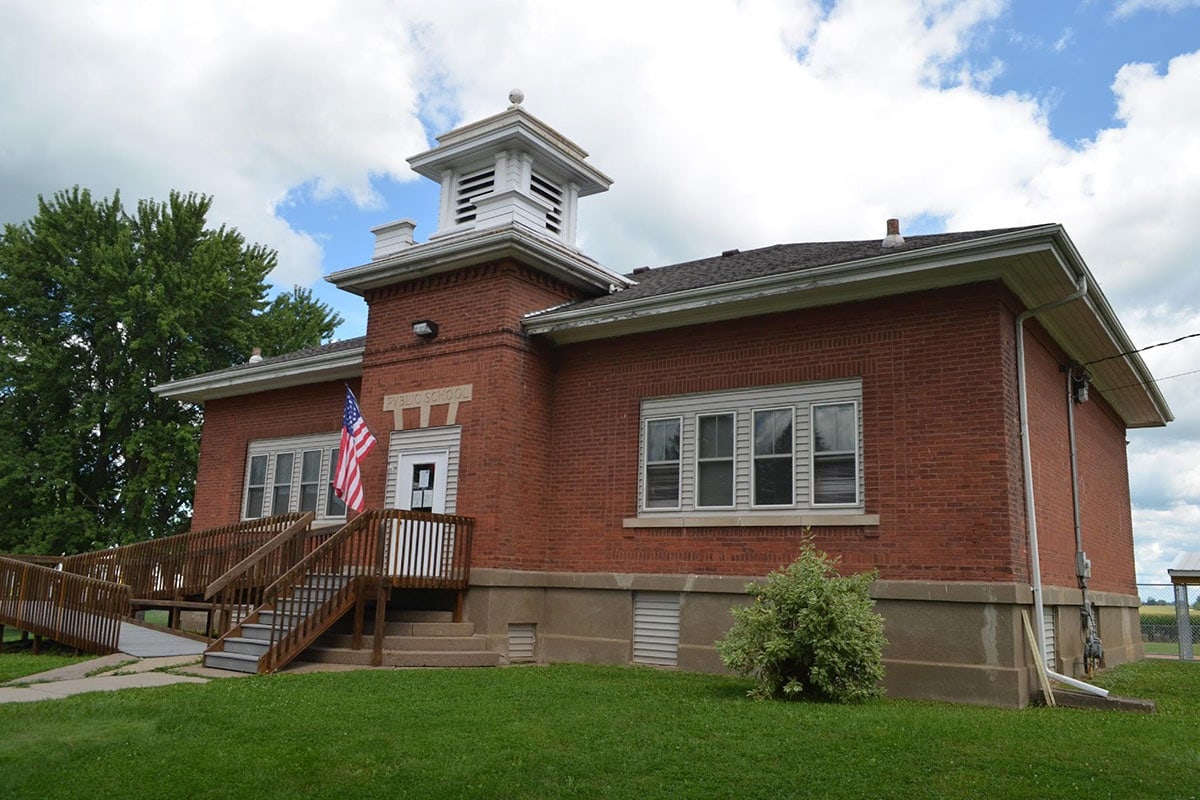
Also, still standing on South Center St. is the historic brick building still known by townspeople as the Utica School. Constructed in 1914, the school housed generations of students until it was closed in 1968, sending first to six grade students into the St. Charles School system. Today the building is used as a community center.
The 1913 Winona County history book reported that during that year Utica had grown to 125 people.
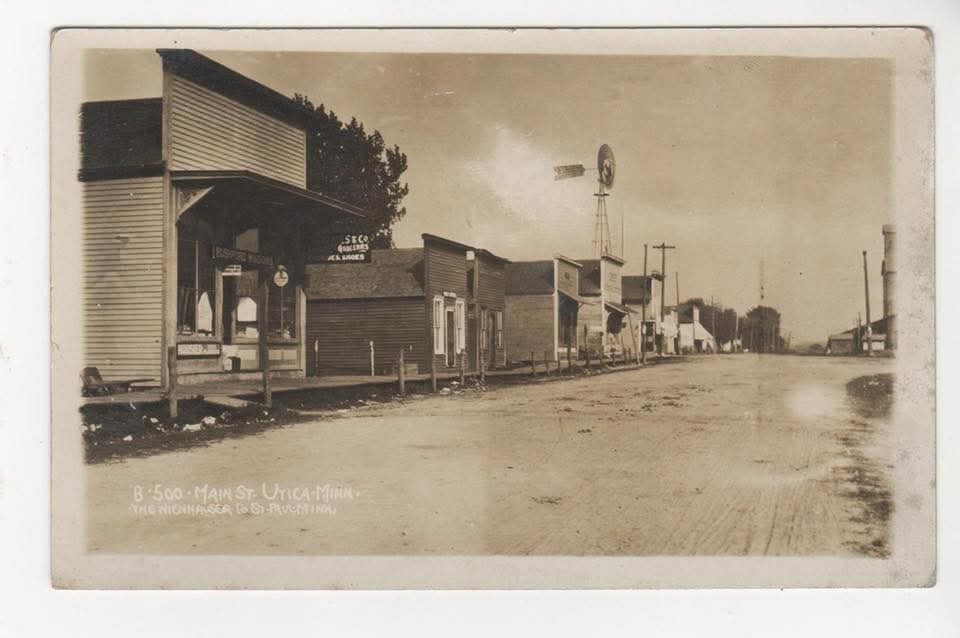
Included in the town were five stores, two blacksmiths, a creamery (closed in 1965), a church and eighth grade school (closed in 1968) and a bank (which closed in 1933).
Utica has celebrated special anniversaries— the centennial on July 26 & 27, 1958, and the 125 th event, June 24, 25 & 26, 1983 and the 150 th celebration August 3, 2008.
The City of Utica is located in the western portion of County of Winona, in Southeastern Minnesota. Utica is on Hwy 14, approximately 15 miles from Winona and 30 miles from Rochester. The population of the City of Utica is 263 as of the 2626.
The area of the City is approximately one square mile. While it contains some agricultural land, it is primarily made up of residential, light industrial and commercial properties. A sewer system and water lines were installed in 1971, and in 2026 the city is nearing the end of a project that included a new well and rehabilitation of the sewer ponds.
Utica contracts with the City of Lewiston for fire protection and ambulance. Winona County Sheriff Department provides law enforcement.
City government consists of a Mayor, elected semi-annually and four Council members who serve for 4-year terms. The Clerk and Treasurer are appointed by the city council.
The City once housed a grocery store, bank, gas station, and other small businesses. Like many small towns most of the small businesses have moved or closed. There is now 1 grain elevator, lumber yard, full service restaurant/lounge and 2 bar & grills, post office and a church.
The City of Utica is part of a wellhead protection plan. Karst topography is typical in this area. There is concern about excess nitrates in the water so water is tested monthly. There also some sink holes around and in town. Canadian Pacific Railroad runs through town and is parallel to Highway 14.